
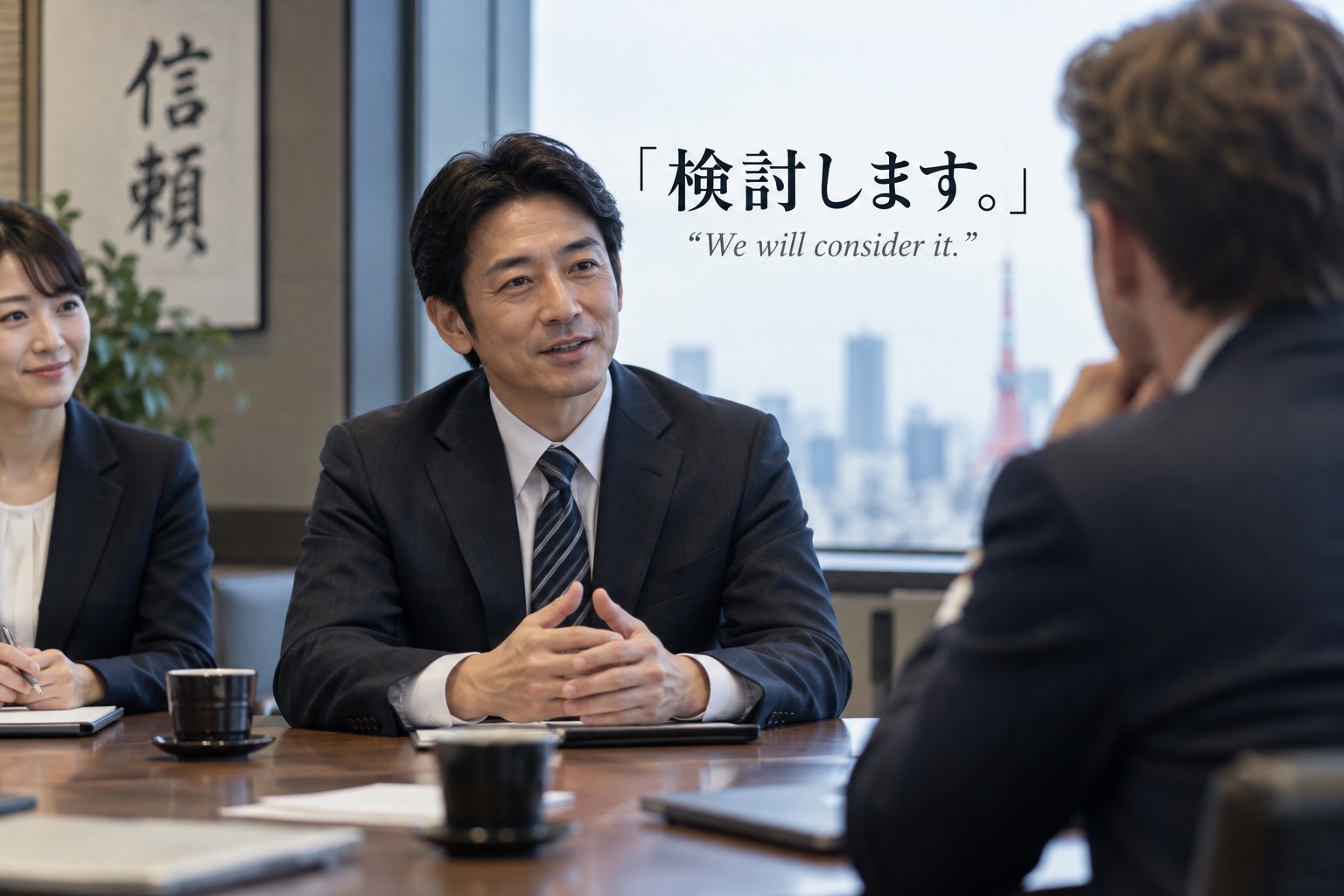
The meeting in Tokyo went well. Everyone was polite, attentive, engaged. At the end, your counterpart smiled and said: “Kentou shimasu” — we will consider it.
You flew home, updated the pipeline to 60%, and waited. Nothing happened.
You followed up. The reply was courteous, warm even — and said nothing new. Weeks later, you are still waiting, wondering what went wrong after such a positive meeting.
Nothing necessarily went wrong. Perhaps the proposal missed the mark. Perhaps a competitor was already ahead. But in many cases, the first misstep happened earlier — at the moment you translated kentou shimasu at face value and gave it a number.
When a manager in Amsterdam or London says “I'll consider it,” the phrase usually carries genuine possibility. It is an invitation to keep the conversation alive.
When a Japanese counterpart says kentou shimasu, the phrase can mean almost anything: genuine deliberation, a holding position while internal alignment begins, or a graceful way to close a conversation without saying no to your face.
Which is why the real mistake is not choosing the wrong percentage. It is assigning a percentage to the phrase at all.
Kentou shimasu does not deserve a pipeline number. On its own, it is not forecast evidence. What matters — what has always mattered — is what comes after it.
In many European business settings, clarity is treated as a form of respect: an early “no” saves everyone's time.
In many Japanese settings, a different value carries equal weight: communicating disagreement without embarrassing the other party in public, and without damaging a relationship unnecessarily. Kentou shimasu works as a cushion — it keeps the room harmonious and lets both sides leave with dignity intact.
Neither approach is wrong. They are two different definitions of politeness — and if you only know one of them, you will keep mistranslating the other.
Here is a practical reading of the most common variations. One caveat first: these are tendencies, not rules — the meaning can shift with the situation, the speaker, and the strength of your relationship.
| What they say | Literal translation | What it often signals |
|---|---|---|
| 検討します — Kentou shimasu | “We will consider it.” | Anything from genuine deliberation to a polite close. On its own, it tells you very little — do not update your forecast on this phrase alone. |
| 前向きに検討します — Maemuki ni kentou shimasu | “We will consider it positively.” | Potentially more encouraging — maemuki (forward-looking) adds warmth — but still not evidence of approval. The real signal is what follows. |
| 持ち帰って社内で検討します — Mochikaette shanai de kentou shimasu | “We will take it back and discuss it internally.” | The decision may not sit with the person in front of you. Your proposal is about to enter the internal alignment process — expect detailed questions to arrive later, one by one. |
Here is the shift that changes how you read every meeting in Japan. Whatever words closed the meeting, ask yourself six questions:
1. Did they name a concrete next step?
2. Did they give a date?
3. Did they request additional information?
4. Did they tell you who needs to review this internally?
5. Did they identify another stakeholder to involve?
6. Was another meeting scheduled?
Now compare two endings.
“Maemuki ni kentou shimasu” — followed by none of the above.
“Kentou shimasu” — followed by “we will check with procurement next week and come back to you on Friday.”
The second is by far the stronger commercial signal, despite the “weaker” phrase. A polite formula with no attached behaviour is decoration. Behaviour — a name, a date, a question, a next step — is the actual message.

Test for behaviour before you leave the room. A respectful question such as “May I ask how this will be reviewed on your side, and when would be a good moment to follow up?” invites your counterpart to attach a process to the phrase. If a process appears, you have evidence of movement. If it does not, treat the opportunity with caution rather than optimism.
Build the relationship, and ask privately. Trust increases your chances of hearing what cannot easily be said across a formal meeting table. If the relationship exists, a one-to-one message — “May I ask where this currently stands internally?” — will often surface an honest reading.
Resist the urge to simply polish the deck. Outcomes in Japan tend to ride on several variables at once: the quality of the proposal, yes — but also internal alignment, perceived risk, implementation confidence, and the relationship behind the proposal. Sharpening the ROI slide addresses only the first of these. If the decision has stalled elsewhere, a better document will not reach it.
Two similar proposals can receive two different answers, depending on who delivered them and what stood behind them.
What looks like hesitation from the outside may reflect something else entirely: internal alignment still in progress, a concern that has not yet been addressed, doubts about implementation, or a relationship that has not yet earned candour. “It's the culture” is the least useful explanation available — the useful question is where, specifically, the decision is sitting, and what would move it.
Why a positive meeting produces no decision — the companion pattern, seen from the pipeline side. Or go deeper with the free field guide Why Your Japanese Partner Says Yes and Nothing Happens.
The Japan Readiness Self-Assessment is twenty questions across five areas — stakeholders, decision pathway, risk signals, message adoption and follow-through. It takes fifteen minutes and shows you where to look first.
The question is not what the phrase means — it is who is aligned, who is not, and where the decision sits. That is exactly what the JSRP Diagnostic establishes. Bring the case to a 30-minute call; no consulting, no pitch.
Book an Initial ConversationGet in touch
Leave your details and we will get back to you within 2 business days. Prefer to talk directly? Book a 30-minute Initial Conversation.
Get In Touch