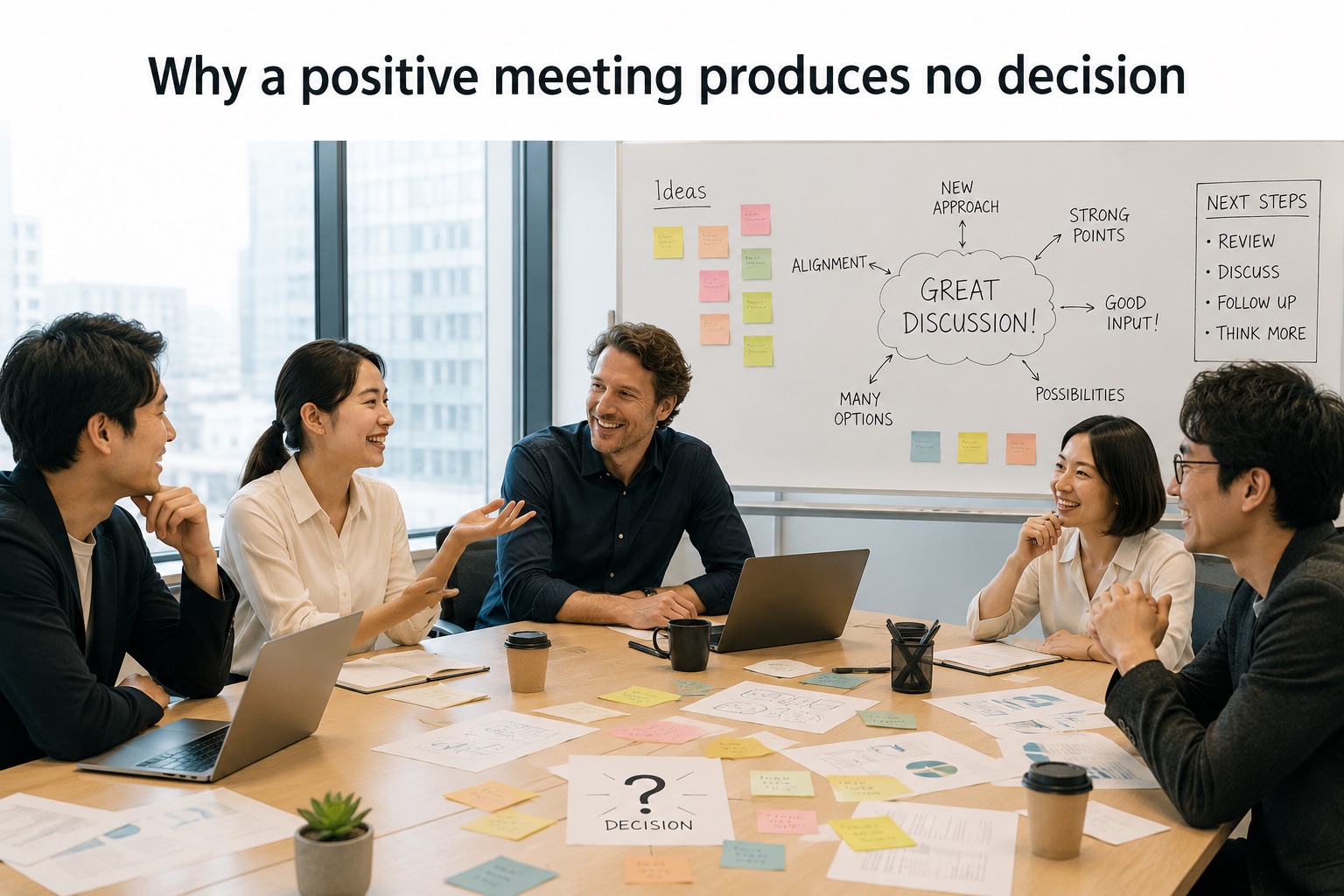
They arrived on time, all four of them. They had read the material — you could tell from the questions, which were specific and, in one case, better than the questions your own side had asked. Nobody objected to the commercial terms. Somebody said the word interesting. At the end, the senior person thanked you for the clear explanation and said they would look into it internally.
That was five weeks ago.
Since then: one short email confirming receipt of the deck. One request for a clarification you had already covered on slide eleven. Nothing else. Your management has started asking whether the opportunity is real, and you no longer have a confident answer.
Two readings tend to compete at this point, and both feel reasonable.
The first is that the warmth was politeness. The meeting was a courtesy; the answer is no; nobody wants to say so directly. The second is that the deal is alive but under-prioritised, and the fix is pressure — a follow-up call, a deadline, an escalation to someone more senior.
Teams often act on the second reading first, and it rarely helps. When it does not, they fall back on the first, and quietly write the opportunity down.
Both readings share an assumption worth examining: that the meeting was where the decision was going to be made.
In many Japanese organisations, the meeting you attended was not the decision point. It was closer to an information-gathering exercise — or, if you were further along than you realised, a confirmation of something already broadly settled.
That has a practical consequence. A positive meeting tells you something real about the relationship and about the quality of your explanation. It tells you much less than you would expect about whether your proposal is moving.
There is a second possibility — and one we see repeatedly in stalled engagements: your proposal has not started travelling yet. Nobody has taken it inward. The people in the room understood it, found it credible, and then returned to their own work — because carrying a proposal into an internal review is a specific act that somebody has to choose to perform, and it costs them something.
This is where the warmth of the meeting can be actively misleading. A meeting can feel excellent precisely because nothing was decided in it. No one had to commit, defend a position, or attach their name to an outcome. Agreement in a room is cheap. Circulating a proposal internally is not.
Authority in the room is not always decision authority. The person who leads a first meeting may be an evaluator rather than a decider — their job is to understand you well enough to describe you accurately to colleagues. They can be entirely sincere in their interest and still hold no power to advance anything.
Consensus is built before it is confirmed. Where a decision requires several departments to have quietly agreed in advance, the visible meeting sits at the end of that process rather than the start. If the internal alignment has not begun, the meeting may produce a favourable impression — but the proposal still has no pathway on which to travel.
Somebody has to take personal risk to move it. Whoever carries your proposal to their colleagues is spending internal credit on you. If it fails, that is remembered. Most European proposals give that person nothing to protect themselves with: no downside case, no continuity with what the organisation already decided last year, no small first step that can be approved without exposure.
None of this is universal. Japanese organisations differ enormously by sector, size and ownership, and some move faster than their European counterparts. But when a positive meeting is followed by silence, this is the pattern worth checking before you conclude that the answer is no.
Disinterest and invisible progress can look identical from Europe for several weeks. Two things help distinguish them.
The type of question, not the speed of reply. Questions that get more specific, more technical, or that arrive from a new direction are often a more useful signal than response time: they can indicate that additional people have entered the review. Questions that repeat what you already answered can mean the same thing — a new reader, starting from the beginning. Generic questions that never get more precise are a weaker signal.
Whether anything is being asked of you at all. A request for a document, a reference, a specification, or a revised figure is often a sign that somebody is preparing to explain you to someone else. Total silence with no requests, over a long period, is the harder signal.
Four things, none of which require a new strategy.
1. Send a record and ask them to confirm it. Within two days, write what was agreed, what was not, and what happens next — short, factual, in a form that could be forwarded without editing. This does two jobs: it surfaces any mismatch in understanding while it is still cheap to fix, and it hands your contact a document they can circulate without having to write one themselves.
2. Ask a pathway question, not a timing question. “When can we expect an answer?” often produces a date estimate without giving you any visibility into the process — and it can read as pressure when the next step is not yet within your contact's control. “Who else would need to look at this before it can move forward?” and “what would they want to see?” are answerable, and the answers are exactly what you are missing.
3. Write the version they can defend. Not the version that persuades you — the version that lets someone junior to the decider present it to four colleagues without you in the room. That means naming what could go wrong and how it is handled, showing how the proposal continues rather than contradicts what they have already committed to, and offering a first step small enough that approving it does not require courage.
4. Find out who would be spending credit on you — and lower the cost. If you cannot name that person, that is the finding, and it is more useful than any timeline. If you can, the question becomes what they need in order to say yes to their own colleagues safely.
Sometimes the answer really is no, and none of this changes it. Sometimes the blockage is price, or product fit, or a supplier already embedded for fifteen years, and no amount of stakeholder mapping will move it.
That is worth establishing early rather than late. But it is a different diagnosis from “the meeting went well and then nothing happened” — and it is worth checking the second before concluding the first.
The difference between a contact and an internal sponsor — the person who likes you may not be the person moving your proposal. Or read how this plays out on a live account in the global heavy industry case study.
The Japan Readiness Self-Assessment is twenty questions across five areas — stakeholders, decision pathway, risk signals, message adoption and follow-through. It takes fifteen minutes and shows you where to look first.
Bring it to a 30-minute call. We will tell you whether it is something we can help with — and honestly if it is not. No consulting, no pitch.
Book an Initial ConversationGet in touch
Leave your details and we will get back to you within 2 business days. Prefer to talk directly? Book a 30-minute Initial Conversation.
Get In Touch