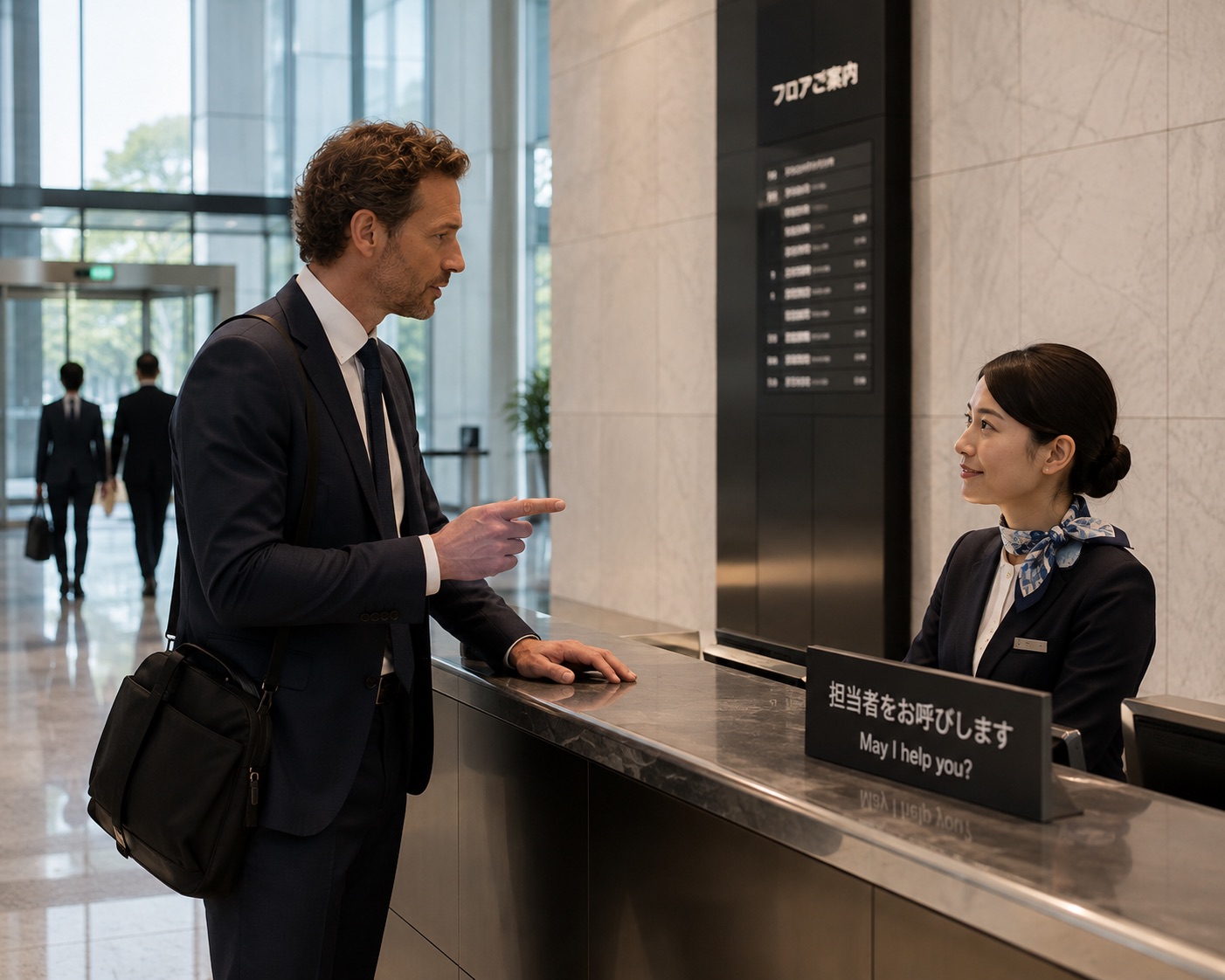
The initial request was straightforward: a business trip to Japan had been confirmed, and the client wanted to learn enough business Japanese to be useful on the ground.
As we talked through the details, a different picture emerged. The trip was not a courtesy visit. It was a commercial negotiation with a Japanese company, built on several months of correspondence, and the visit was intended to move that process forward.
So we said what we thought: at this stage, time invested in learning Japanese would have almost no effect on the outcome of the negotiation. Interpreters would be present. The counterpart's team worked in English. What actually needed to be learned in the time available was how the Japanese organisation would reach its decision, and how to earn credibility in the room while that process ran.
We kept a short travel Japanese component, and rebuilt the core of the programme around business protocol and decision-making structure.
The programme began by mapping the counterpart organisation: which division held the relationship, the title and actual authority of the day-to-day contact, who sat above that contact, how previous proposals had been handled internally, and how the tone of responses had shifted over time. Alongside the client interviews, we researched the organisation independently.
One finding changed the entire preparation.
The person the client believed to be the key decision-maker had someone above them holding final responsibility.
The contact was engaged, responsive, and clearly advocating for the proposal internally. All of that was real. But the authority to approve the deal sat elsewhere. In practice, every proposal, document and conversation so far had been addressed to the person who moves a decision forward — not the person who makes it.
This is not unusual in Japanese organisations. But from the outside, the structure is almost invisible.
From there, we rebuilt the preparation around two audiences rather than one. The relationship with the day-to-day contact remained essential and was treated as such. What we added was a track aimed at the person behind them:
In Japanese organisations, proposals move before and after the meeting rather than during it. Documents are not read in the room; they circulate afterwards. Once that is understood, the shape of what you prepare changes.
In each case we covered the reasoning, not only the form. Rules that are understood can be applied to situations nobody prepared for.
The client had already received guidance from an acquaintance with real experience of doing business in Japan. It was sound advice, grounded in practice. But that person was operating from inside a relationship built over many years.
How you behave once trust is established is not how you behave while you are still earning it. The directness and shorthand that a long-standing partner can use comfortably will read, at a first meeting, as insufficient preparation or a lack of seriousness. We said this plainly, and then separated out the elements that genuinely apply to a first visit.
The final stage was a simulation of the negotiation itself: handling anticipated questions, responding when a meeting goes quiet, confirming next steps in a way that supports approval rather than forcing it, managing conversation over dinner — all rehearsed aloud.
Arriving in Japan having already done it once, even in rehearsal, makes a measurable difference on a first visit.
The relationship with the existing contact deepened. And because the client already knew that a final decision-maker existed, that relationship could be built properly as well, rather than discovered late.
The negotiation concluded with a signed contract.
Had the client travelled without knowing about the second stakeholder, the likely result would have been a warm relationship with the contact, a decision that failed to progress, and no clear explanation as to why.
A request framed as a language problem often turns out to be a structural one. What feels like difficulty communicating is frequently difficulty identifying who is being communicated with.
Start with the Japan Business Trip Preparation — or, if the engagement is already running, a Diagnostic of where it stands.
A 30-minute call to check what your trip actually needs — and to tell you honestly if it is not something we should prepare together.
Book an Initial ConversationGet in touch
Leave your details and we will get back to you within 2 business days. Prefer to talk directly? Book a 30-minute Initial Conversation.
Get In Touch