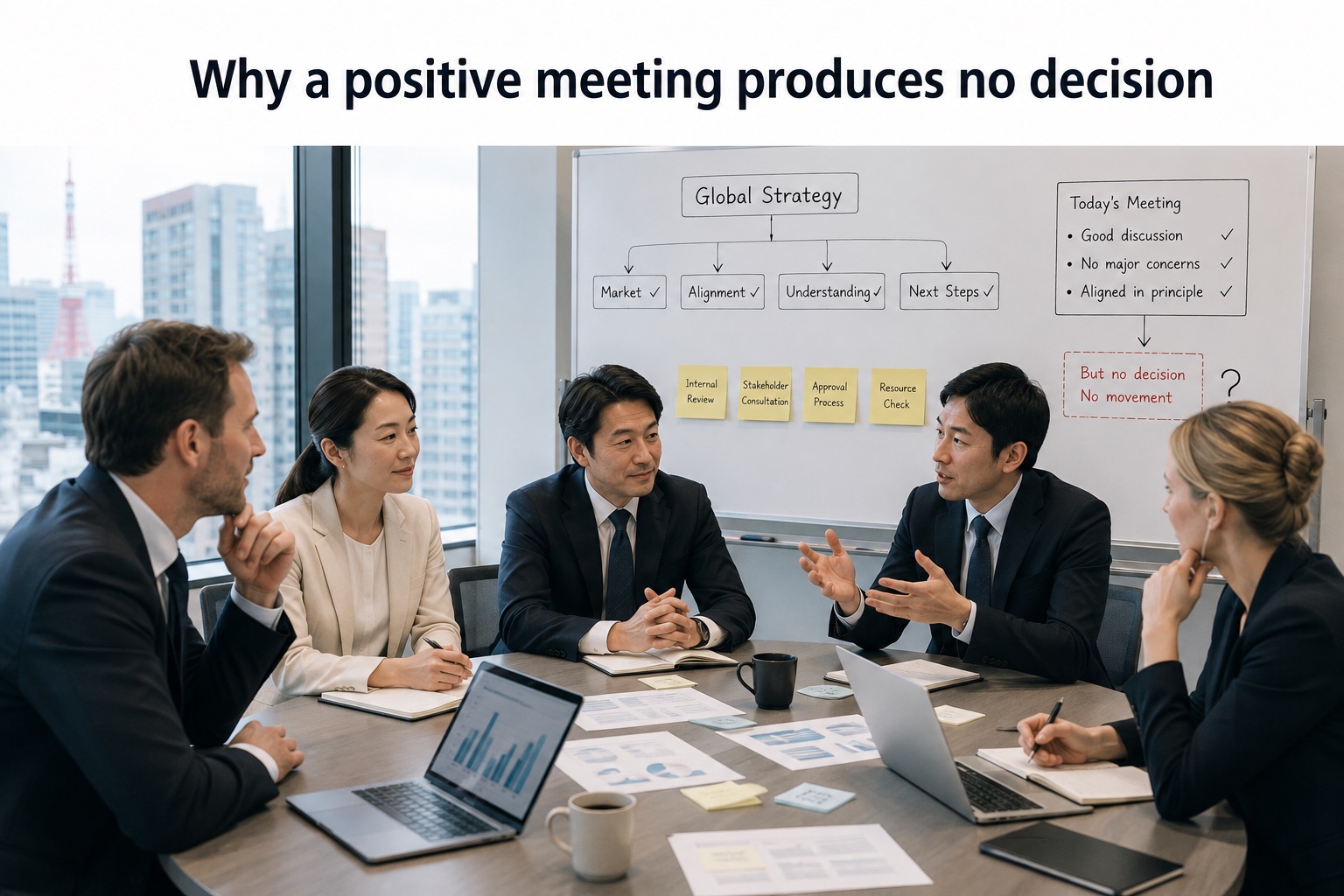
The global programme launched in April. Fourteen markets, one operating model, a reasonable timeline.
Japan has attended every call. Two people, sometimes three, cameras on, always on time. They have never once pushed back on the strategy. When the regional lead asked directly whether there were concerns, the answer was that they understood the direction and would review it internally.
Thirteen markets are somewhere on the adoption curve. Japan's numbers have not moved. The templates come back late and partially completed. Last month there was a request for a market-specific exception, the third one, on a point you thought had been settled in June.
Nobody has said no. Nothing is happening.
A common reading is that this is passive resistance — polite disagreement expressed as delay, because the local organisation does not want the change and will not say so.
A second reading is that it is a capacity problem. Japan is under-resourced, the team is stretched, and the fix is more support, a clearer deadline, or a conversation between the regional director and the Japan MD.
The interventions that follow are usually some combination of mandate, KPI and escalation. When those produce compliance on paper without movement in the numbers, the conclusion tends to harden into the first reading.
Both readings assume that Japan received a decision and chose not to act on it. It is worth checking a different possibility first.
In many Japanese organisations, a global decision is not the end of a decision process. It is an input to a local one.
That distinction sounds procedural and is not. Your Japan colleagues may fully accept that headquarters has decided, agree with the direction, and still be unable to implement — because within their own organisation, the change has not yet been through the internal alignment that makes execution possible. Budget owners have not signed off. The affected functions have not been consulted. Nobody has taken the programme inward and put their name to it.
From Europe, that period looks identical to resistance. From Tokyo, some of that period may be the work of turning a directive into something the organisation can actually execute.
There is a second thing worth understanding. Where direct objection carries social and professional cost, disagreement often travels through other channels: detailed questions, requests for clarification, requests for exceptions, and a slower response cycle. A team that raises three technical questions about your data model may not be stalling — they may be telling you, in the register available to them, that the model does not fit something on their side.
“No objection” describes what was not said in a meeting. It is a weak indicator of what will be done.
Agreement to a strategy is not agreement to its operating consequences. At the point of the global call, the local consequences are often genuinely unknown — which systems change, which customers are affected, which internal agreements would have to be renegotiated. Assent given before that work is done is provisional, whether or not anyone says so.
Objection is expensive; questions are cheap. In an environment where visible disagreement with headquarters carries a cost, questions and exception requests are the low-cost channel. This is not unique to Japan — it happens in any group with a strong centre. What can be distinctive is how easy the signal is to miss where direct disagreement tends to be withheld until internal alignment is clearer. Treating those questions as friction to be minimised removes the feedback mechanism you have.
A global decision still needs a local execution pathway. A decision made in Europe does not substitute for the internal process that authorises spending, changes a workflow, or alters a customer commitment in Japan. Somebody local has to carry it through that process. If nobody has, the programme has no pathway on which to travel — regardless of how clearly it was announced.
Four signals, more useful than attendance or acknowledgement.
Are the questions becoming more operational? Questions moving from “why” to “how” — systems, sequencing, who does what in which month — often indicate that the programme is being examined by people who would have to run it. Questions that stay conceptual across several cycles are a weaker signal.
Are new people appearing? A finance or operations name joining a call that used to be marketing-only is often a stronger signal of movement than another verbal confirmation.
Are they asking for exceptions? Counter-intuitively, a specific, well-argued exception request is often a sign of engagement. It means somebody has read the programme against local reality closely enough to find the collision. Generic agreement with no requests is the harder signal.
Is anything being produced locally? A local version of the plan, a budget line, an internal briefing document. Artefacts are evidence; attendance is not.
1. Stop asking for confirmation. Ask for the local operating consequence. “Do you have any concerns?” invites the answer you have been getting. “What would have to change on your side in the first ninety days, and who would need to approve each of those?” is answerable, and the answer tells you where the programme actually is.
2. Supply the version they can take inward. Global decks are written to align a region. They are rarely written to be circulated inside a Japanese subsidiary for approval. That version needs the downside case written out, continuity with what the Japan organisation already committed to, and a first phase small enough to authorise without escalation. Producing it is headquarters' job, not a favour.
3. Design the exception process deliberately. If there is no legitimate route for “this part does not work here,” the objection does not disappear — it re-emerges as delay. A defined, time-boxed exception process converts an invisible problem into a decision you can make.
4. Measure adoption by artefact, not by attendance. Ask for the local plan, the named owner and the approval date. Track those. Presence on a call is not progress, and reporting it as progress delays the point at which you learn otherwise.
Sometimes the programme genuinely does not fit. The channel structure is different, the regulatory position is different, the customer expectation is different, and the Japan organisation is right. Persistent non-adoption is occasionally the market telling you something that the global model did not anticipate.
And sometimes the constraint is neither cultural nor commercial but temporal: the global timeline assumed a decision cycle that does not exist locally, and no amount of internal alignment will compress it to fit.
Both of those are findings worth having early. Neither is visible from a call where nobody objected.
See how a global marketing team worked through exactly this pattern in the global consumer goods brand case study — or read more about getting global initiatives adopted in Japan.
The Japan Readiness Self-Assessment is twenty questions across five areas, including whether your proposal exists in a form the Japan organisation can approve internally. It takes fifteen minutes.
Bring one concrete rollout to a 30-minute call. We will tell you whether it is something we can help with — and honestly if it is not. No consulting, no pitch.
Book an Initial ConversationGet in touch
Leave your details and we will get back to you within 2 business days. Prefer to talk directly? Book a 30-minute Initial Conversation.
Get In Touch